Description
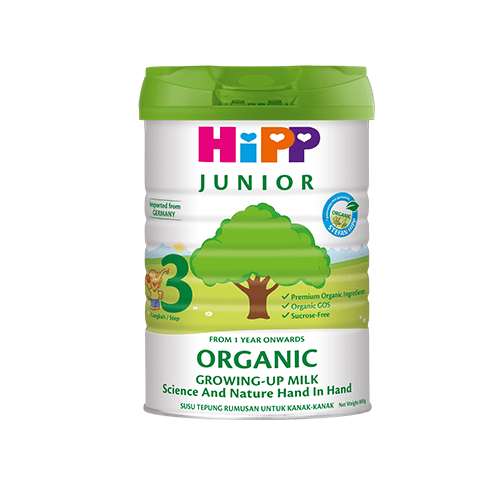
HiPP JUNIOR Organic growing-up milk has been developed on the model of both science and nature hand in hand. Inspired by the benefits of nature, HiPP JUNIOR Organic Growing-up Milk is specially formulated using only the finest organic milk and strictly controlled organic ingredients to help support your child’s optimal growth and development from 1 year onwards.
All the organic ingredients used in HiPP JUNIOR Organic Growing-up Milk are tested at every stage of production for purity to ensure that it is free from unwanted chemicals.
It has been awarded the rating of ‘recommended’ in Greenpeace’s shopping guide ‘Food Without Genetic Engineering’.
Produced according to strict organic regulations.
| FREE FROM any use of: |
Produced and formulated to be FREE FROM: |
| Chemical synthetic pesticides or insecticides |
Added Sugar & Gluten-containing ingredients |
| Artificial hormones / Growth hormones |
Artificial flavors* |
| Prophylactic use of antibiotics |
Artificial colors* |
| Artificial fertilizers |
Soy protein |
| GMO-food |
* as required by law |
FAQs
1) Organic formula – what makes it organic?
Organic Cows spend as much time as possible grazing on meadows where they can move around freely and eat lots of clover-rich grass. All organic cows must be fed on a 100% organic diet.
The organic cows are fed on as natural a diet as possible and not pushed to give more milk than they naturally produce. On some non-organic farms, cows will be bred to produce high volumes of milk which can badly affect their health and life expectancy, and they may not have any access to pasture or grass-based food at all.
2) What is the difference between Naturally occurring sugars vs added sugars?
Naturally occurring sugars are found in milk (lactose) and fruit (fructose). Any product that contains milk (such as yogurt, milk or cream) or fruit (fresh, dried) contains some natural sugars.
Added sugars can be found as ingredients in processed foods or drinks during preparation.
The naturally occurring sugar of cow’s milk is lactose. This is also the case for formulae based on cow’s milk. However, some cow’s milk based formulae use added sugars as caloric sweeteners or to completely replace lactose. Some examples of added sugars in milk formulae based on cow’s milk are sucrose, maltodextrin, fructose, corn syrup solids, and glucose syrup. View more references.
3) What do the Health Experts say?
The Health Experts say “Avoid added sugars for children below 2 years”
The American Academy of Pediatrics (AAP) advise that children younger than the age of two should avoid added sugars in their diet as too much added sugar puts children at risk for obesity, tooth decay, heart disease, high cholesterol, high blood pressure, type 2 diabetes and fatty liver disease, among other health problems.¹
Cow’s milk has the natural milk sugar lactose which is packed with multiple health benefits and the energy needed for the child’s growth and development. ²
At HiPP, we put children in the center of attention by carefully selecting ingredients that are closest to nature. Inspired by nature, HiPP Junior Organic uses only the natural milk sugar Lactose, without the use of added sugars. Give your child HiPP Junior Organic. Help support your child’s health and development with organic and naturally-sourced ingredients.
Ref:
1. https://publications.aap.org/aapnews/news/7331
2. Gunnerud, U.; Holst, J.J.; Stman, E.; Björck, I. The glycemic, insulinemic and plasma amino acid responses to equicarbohydrate milk meals, a pilot-study of bovine and human milk. Nutr. J. 2012, 11, 83.
4) How to develop a child’s preference for healthy food for life?
An intake of added sugars in early life creates a preference for sweet foods throughout life.
Food preferences in children first start in the womb with the diet of their mother, and after birth with their early childhood diet.¹ Early exposure to sweetened food, or food with added sugars during processing or preparation, can lead to an increased preference for sweet foods throughout life.²⁻⁴
What parents can do to develop their children’s preference for healthy foods.
It is important to have a balanced diet during pregnancy as a child’s sense of taste and smell develops before birth.⁵ Research has shown that pregnant mothers’ food choices mould their unborn child’s food preferences. This is referred to as “programming”.⁶
While a child is able to perceive flavours while still in the womb, their sense of taste continues to evolve throughout childhood. A varied diet low in processed foods and added sugars is important in shaping a child’s healthy food preferences and will have a lasting impact on their life.
Ref.:
1. Mennella JA, Beauchamp GK. Early flavor experiences: research update. Nutr Rev. 1998;56(7):205-211.
2. Beauchamp GK, Moran M. Dietary experience and sweet taste preference in human infants. Appetite. 1982;3(2):139-152.
3. Beauchamp GK, Moran M. Acceptance of sweet and salty tastes in 2-year-old children. Appetite. 1984;5(4):291-305.
4. Liem DG, de Graaf C. Sweet and sour preferences in young children and adults: role of repeated exposure. Physiol Behav. 2004;83(3):421-429.
5. Robinson S, Fall C. Infant nutrition and later health: a review of current evidence. Nutrients. 2012;4(8):859-874.
6. Muniandy ND, Allotey PA, Soyiri IN, Reidpath DD. Complementary feeding and the early origins of obesity risk: a study protocol. BMJ Open. 2016;6(11):e011635. Published 2016 Nov 15.